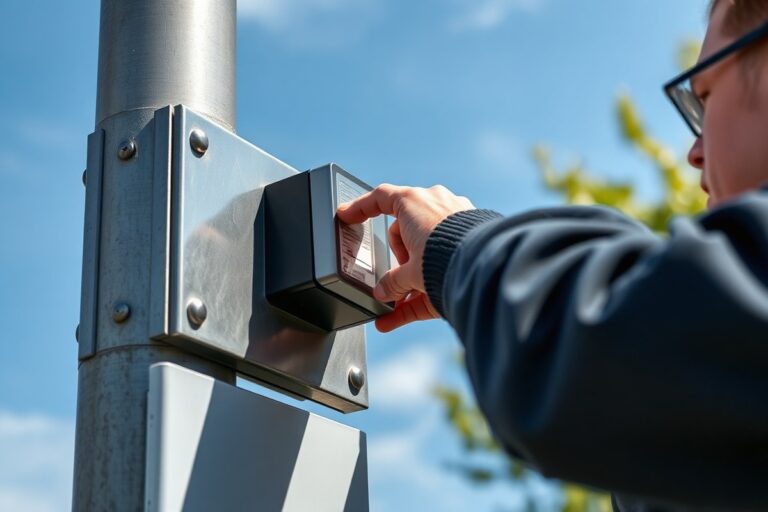
ADA Parking Sign Height: Essential Rules and Mounting Checklist
ADA parking signs must be installed with the bottom edge positioned at a minimum height of 60 inches above the finished parking surface according to federal regulations. This height guarantees clear visibility and easy access for drivers, including individuals using wheelchairs or mobility devices. Begin the installation by precisely measuring the distance from the parking lot surface to the sign’s bottom edge before mounting.
Key Takeaways
- Measure from the finished parking surface to the bottom of the sign, ensuring a minimum height of 60 inches.
- Mount all accessible parking signs securely to maintain consistent height over time, especially after resurfacing.
- Use signs at least 12 by 18 inches with clear “Van Accessible” wording for van-designated spaces.
- Van-accessible spaces require a minimum vertical clearance of 98 inches for vehicle lifts and access aisles.
- Place signs at the front of the parking space to clearly mark accessible spots.
- Check local or state codes for additional signage or size requirements beyond federal rules.
What Is the Required Height for ADA Parking Signs?
The required height for ADA parking signs is a minimum of 60 inches measured from the finished parking surface to the bottom edge of the sign. This measurement ensures that the sign remains clearly visible when a vehicle is parked in the accessible space. The 60-inch bottom edge height is a federal standard mandated by the ADA, which helps maintain uniformity and enforceability across parking facilities. Measuring to the bottom edge is important because it accounts for variations in sign size and mounting methods while keeping the sign legible and unobstructed.
The height requirement for signs does not change for van-accessible parking spaces. Signs for all accessible spots, including van-accessible ones, need to have their lowest edge mounted no less than 60 inches above the ground. Van-accessible signs must also include the phrase “Van Accessible” along with the International Symbol of Accessibility. This label alerts drivers that the space fits vans with lifts or ramps, which need a vertical clearance of at least 98 inches. Keeping the sign at this height makes sure it stays visible over larger vehicles parked in these spaces.
The rationale behind the 60-inch minimum height is rooted in visibility and accessibility. Signs placed too low risk being blocked by parked vehicles, landscaping, or snow buildup, which would defeat their purpose. They also help drivers with disabilities quickly identify designated parking spots and prevent unauthorized use. By requiring the bottom of the sign to be 60 inches high, the ADA standard minimizes the chance of visibility being obstructed and supports consistent parking lot design and enforcement practices. This height also accommodates wheelchair users approaching the stall and enforcement officers who need a clear line of sight.
To comply, measure from the finished parking surface directly beneath the signpost up to the bottom edge of the sign. Ensuring the surface is finished is important because resurfacing can lower sign height if not accounted for. When installing or adjusting signs, use a reliable tape measure or laser level for accuracy. The installation should place the post and sign permanently at or above 60 inches on the finished surface and make adjustments if overlays or wear occur over time. Failing to meet this standard can result in citations, fines, or retrofitting costs ranging from $50 to several hundred dollars depending on sign replacement and installation labor.
Proper adherence to the 60-inch bottom edge height supports clear communication of parking accessibility. Variations in local or state codes may require additional elements like fine amounts or color schemes, but federal rules on height remain the baseline. Keeping this height intact through maintenance and resurfacing protects the property from compliance violations. Signs mounted too low or shared between two spaces often create confusion and accessibility barriers, undermining the ADA’s goal to provide equal parking access for persons with disabilities.
How to Measure and Mount ADA Parking Signs Correctly
Mount ADA parking signs with their bottom edge no less than 60 inches above the finished surface of the parking lot. This placement guarantees the signs remain visible and accessible, complying with essential ADA rules. Use accurate measuring tools and follow exact installation steps to prevent costly fixes or violations.
Measuring from Finished Parking Surface
Measuring sign height must start from the finished parking surface, not the underlying ground or any previous pavement level. The finished surface includes any overlays, seal coats, or surface treatments applied after initial construction. Measuring from this level guarantees the sign stays compliant even as the surface changes over time.
Use a tape measure to determine the height from the ground level where the sign post or wall meets the parking surface up to the lowest edge of the sign. The bottom edge must be at least 60 inches above this finished surface to ensure visibility to drivers and accessibility for enforcement.
Selecting Mounting Location and Height
Signs should be mounted either on poles positioned within or adjacent to the accessible parking spaces or on walls that line the parking area. Poles are more common and offer greater flexibility in height adjustment. Wall mounting is allowed, but confirm the sign is clearly visible without obstruction and that the height meets or exceeds the required 60-inch minimum.
Mount the sign directly at the head or side of each designated accessible parking space and van-accessible spots. Avoid locations too far back from the space as this can reduce visibility and enforceability. Confirm that any existing or new surface treatments will not reduce the final height below compliance.
Verifying Compliance with a Tape Measure
Use a tape measure and digital level to verify the sign’s mounting height after installation. This ensures the bottom edge of the sign is at least 60 inches from the finished parking surface. Conduct this check after every resurfacing or maintenance project that alters the parking surface height.
To maintain compliance, regularly inspect all accessible parking signs, especially if a site undergoes renovations. Confirm sign placement, height, and clarity to avoid fines and maintain accessibility for users with disabilities. Follow these steps to measure and mount ADA parking signs correctly:
- Inspect the current parking surface and confirm it is the finished level for measurement.
- Measure from the finished surface up to the lowest edge of the existing sign or planned mounting point.
- Position the sign mounting pole or bracket so the bottom edge will be at least 60 inches above the finished surface.
- Mount the sign securely on a pole or wall directly adjacent to the accessible parking space.
- Use a tape measure to verify the bottom edge height after installation.
- Check that the sign is visible with no obstructions from vehicles or landscaping.
- Document the sign height and location for ADA compliance records.
- Plan to re-measure after any resurfacing or overlay work on the parking lot.
Always measure sign height from the finished parking surface to avoid non-compliance after resurfacing projects change the ground level.
Differences in Signage for Van-Accessible Parking Spaces
Van-accessible parking spaces have distinct size, clearance, and signage requirements to accommodate wheelchair vans and their lifts. These spaces must have specific minimum widths, access aisle dimensions, and at least 98 inches of vertical clearance. The signage must clearly state “Van Accessible” beneath the International Symbol of Accessibility to identify the space for drivers of accessible vans.
Van-Accessible Space Dimensions and Clearance
A van-accessible parking space must follow one of two size options: either a 132-inch-wide space with an access aisle of at least 60 inches or a 96-inch-wide space paired with a 96-inch-wide access aisle. This allows parking lots to fit different layouts while still providing enough room for vans that accommodate wheelchairs.
The vertical clearance requirement for these spaces is at least 98 inches, measured along the parking space, the access aisle, and the vehicular route leading to the space. This clearance accommodates van lifts and ensures that vans with raised roofs can park and exit safely without obstructions, which standard accessible spaces do not require.
Required Wording and Symbols for Van-Accessible Signs
Van-accessible parking signs must include the International Symbol of Accessibility (ISA) and the phrase “Van Accessible” placed directly below the symbol. This additional wording is mandatory to distinguish these spaces from standard accessible spaces and to guide drivers who need the extra width and clearance van access requires. It helps prevent wrongful parking and ensures accessibility for van users.
Signs need to be reflective and designed for clear visibility at all times. While additional details like logos or branding can be included, the core requirements of the ADA must be maintained. The phrase “Van Accessible” is mandatory on signs for van-accessible parking spots.
Mounting Height Specifics for Van Signs
Signs marking van-accessible parking should be mounted so the bottom edge is no less than 60 inches above the ground, measured from the parking surface. This matches the height requirement for standard accessible parking signs and keeps the sign clearly visible over vehicles and away from visual obstructions like landscaping or pedestrians.
Mounting the sign at this height also allows drivers to easily see it when approaching the parking space from a vehicle, which is important for identifying van-accessible spots quickly. Despite the unique clearance needs for van spaces, the sign height standards remain uniform across all accessible parking signage to maintain consistency and compliance.
How Resurfacing and Overlays Affect ADA Sign Height Compliance
Resurfacing or applying an overlay on a parking lot surface can directly affect the height of ADA parking signs. Since ADA rules require the bottom edge of signs to be at least 60 inches above the finished surface, raising the surface level changes the sign’s relative height. Without adjustment, a resurface can lower the sign height below the minimum, causing noncompliance and potential accessibility issues.
Before any overlay or resurfacing, measure and document the current height of all ADA parking signs from the ground to the bottom edge. You can expect overlays or resurfacing to add 0.5 to 2 inches of thickness, depending on materials and methods used. For example, a typical asphalt overlay often adds roughly 1 inch, but thicker sealcoats or multiple layers can exceed that amount.
To maintain compliance, plan to raise or reset the signposts after resurfacing. This can mean pulling out the existing post and re-installing it to the correct height adjusted for the new surface elevation. Sometimes, simply extending the post or using a taller mounting bracket suffices. Ideally, coordinate with your paving contractor so sign adjustments happen immediately after the new surface is laid but before striping and lot reopening. This helps avoid temporary violations and the extra cost of a second site visit.
Costs for adjusting sign height vary by method. Installing new posts can range from $150 to $300 each, including labor and materials, while using extension brackets may be less expensive but must be sturdy and code-compliant. Ignoring this step risks fines and liability if your parking lot is inspected. A professional ADA compliance or pavement contractor can provide an assessment and quote ahead of time.
For small overlays, you might raise signs by simply adding riser tubes or sleeves to existing posts, saving time and money. With full parking lot reconstructions or thick mill-and-overlay projects, plan to reset all posts entirely. Keeping a clear record of sign heights and overlay thickness prevents surprises and ensures your signs remain at least 60 inches above the final finished surface after resurfacing.
After resurfacing, inspect every ADA parking sign immediately to confirm height compliance. Signs partially buried or with posts sunken into soft substrate risk falling below 60 inches quickly. Signs must also remain visible, so check for new landscaping or curb elevation changes caused by overlays that might block sight lines. Regular maintenance following resurfacing can prevent new violations from creeping in with normal lot wear.
Federal vs State and Local ADA Parking Sign Height Requirements
The federal ADA sets baseline standards for parking signage, including the minimum heights and mounting specifics needed for accessible parking spots. These baseline standards ensure that signs are visible and readable to all users. State and local governments often add their own requirements, which may specify sign size, color, additional text, or pavement markings that federal rules do not detail.
To ensure full compliance, first identify the applicable federal ADA regulations, such as those found in the 2010 ADA Standards for Accessible Design. Then review your state and local codes, which could be found in municipal ordinances, transportation department rules, or state accessibility codes. State requirements sometimes mandate sign sizes, wording differences (such as adding “reserved” or fine penalties), or color contrasts exceeding federal minimums. These additions have their own enforcement mechanisms and penalties, so compliance is critical to avoid fines or legal issues.
A simple decision rule helps: follow the stricter criteria when state or local sign height or other specifications exceed federal minimums. The federal ADA minimum height for bottom edge of signs is typically 60 inches above the ground, but if your state code requires 65 inches, you must follow 65 inches. Similarly, if federal ADA leaves size or color open and local rules specify larger or more reflective signs, those local requirements prevail. Always use the most restrictive standard for each sign attribute to maintain compliance. The table below outlines common federal versus state/local differences in ADA parking sign requirements:
| Requirement Aspect | Federal ADA Standard | Example State/Local Additions |
|---|---|---|
| Sign Height (Bottom Edge) | Minimum 60 inches | Some states require 65 inches |
| Sign Size | No set federal size | Local codes often specify minimum sign dimensions |
| Sign Text Content | Must include International Symbol of Accessibility | Additional wording like “Reserved Parking” or fine amounts |
| Sign Color and Contrast | Standard blue and white | Higher contrast or reflective materials required locally |
| Parking Space Markings | Basic striping per ADA | Local mandates on pavement symbols and additional markings |
| Legal Terminology | Uses “accessible parking” broadly | Some states use term “handicap” as per MUTCD/R7-8 codes |
Checking local laws is not optional because state and municipal codes frequently clarify or impose stricter rules than the federal ADA. Often, state-level signage guides or transportation agency documents provide detailed sign specifications that you must follow.
A good practice is keeping a compliance checklist that compares the federal minimums with your local rules for every parking sign attribute. Consult your local building or transportation department for current requirements and confirm any updates frequently. Noncompliance risks fines, removal orders, or lawsuits, which can cost thousands.
Always verify your local codes before installing or replacing signs to avoid costly penalties for noncompliance with state-specific ADA parking sign regulations.
Common Mistakes and Fixes in Mounting ADA Parking Signs
Common installation mistakes can prevent ADA parking signs from being visible and compliant. One frequent error is mounting signs lower than 60 inches above the ground, which is below the minimum height mandated by federal regulations. Signs mounted too low risk being obscured by parked vehicles or snow, reducing their visibility to drivers and enforcement officers.
Another typical issue is placing the sign too far back from the parking space. The sign should be positioned at the front of the designated accessible space so it is clearly associated with that spot. Obstructions such as landscaping, poles, or other signage can also block the view of the ADA sign, so installers must take care to avoid these barriers.
Some property managers mistakenly use only ground-painted symbols instead of physical signs. Painted markings do not satisfy ADA requirements on their own and cannot replace the mandatory vertical signs. Both signs and pavement markings complement each other to clearly indicate accessible parking.
- Mount the bottom of the ADA parking sign at least 60 inches above the finished grade, measuring from the pavement to the sign’s bottom edge.
- Place signs directly at the front of the accessible parking stall to ensure clear association and visibility.
- Keep the sign location free from obstructions like shrubs, tree limbs, and other signs that can block the view.
- Use two signs per accessible parking space when required, both meeting the height and placement rules.
- Do not rely solely on painted ground symbols as substitutes; install vertical signs to meet compliance.
- Confirm sign colors and contrast meet ADA color standards for clear recognition in daylight and low-light conditions.
Following these steps helps keep your ADA parking signs fully compliant and visible. This attention to proper height, placement, and obstruction-free sightlines reduces enforcement challenges and supports accessibility standards. Fixing errors early prevents costly reinstallation or penalties in the future. When mounting signs, use a level and a measuring tape to verify the 60-inch minimum height and correct positioning to the parking space’s front curb or wheel stop. Expect to spend about 30 minutes per sign for careful installation, including time to clear any obstructions. Visibility is the goal: the sign should be easily seen from the driver’s seat on approach and clearly designate the accessible spot.
Maintenance and Enforcement of ADA Parking Sign Height Rules
Maintaining ADA parking signs at the correct height requires regular inspections and updates, particularly in busy locations or after landscaping and paving work. Signs can be damaged, obscured by vegetation, or shifted from their original spots. Inspect at least twice a year to ensure signs are installed properly, with the bottom edge positioned at a minimum height of 60 inches above ground and fully visible. Use tools like a tape measure and level to check their placement, and watch for deterioration such as fading, peeling, or graffiti that affects readability. Replace or reposition signs that fail to meet height requirements or are misaligned. Business owners and property managers should keep records of these inspections to demonstrate ADA compliance when required.
Noncompliance with ADA parking sign height requirements carries legal and financial risks that can impact your property. Regulatory authorities may issue citations or fines for failure to meet signage standards, which can range widely depending on the jurisdiction. For example, federal ADA enforcement may impose civil penalties reaching thousands of dollars per violation in severe cases or repeated offenses. Local or state codes often add their own penalties for inadequate accessible parking signage. Beyond fines, corrective orders often require expedited sign replacement or repositioning that can increase costs if delayed. Also, poor signage can lead to lawsuits from individuals with disabilities or advocacy groups, resulting in potential settlements and legal expenses.
Consistent signage maintenance preserves both compliance and the safety of people relying on accessible parking. Prepare a simple script for inspection staff or contractors: start by visually verifying each parking stall’s sign is clean and unblocked, then measure from the finished ground to the sign bottom, targeting the 60-inch standard height. Confirm signs display required tactile and visual elements, including raised characters and braille where applicable. Keep spare signs on hand to replace any that show excessive wear or vandalism immediately. Staying proactive in maintenance reduces risks of costly legal penalties and ensures your parking facilities meet the spirit and letter of ADA requirements.
How Many ADA Parking Signs Are Required and Where to Place Them
The number of ADA parking signs required depends on the total number of accessible spaces and whether those spaces are standard or van-accessible. Signs must be placed to clearly identify each accessible parking spot and passenger loading zones according to lot layout and local enforcement rules. Vertical clearance and aisle widths affect design decisions, especially for van-accessible spaces and loading areas.
Sign Quantity Based on Parking Lot Size
The 2010 ADA Standards mandate a minimum number of accessible parking spaces depending on the total parking spots. At least one in every six accessible spaces must be van-accessible, each requiring its own signage with the International Symbol of Accessibility. Small lots with four or fewer parking spaces do not require any identification signs, including accessible spots.
| Total Number of Parking Spaces | Minimum Number of Accessible Parking Spaces Required |
|---|---|
| 1 to 25 | 1 |
| 26 to 50 | 2 |
| 51 to 75 | 3 |
| 76 to 100 | 4 |
| 101 to 150 | 5 |
| 151 to 200 | 6 |
| 201 to 300 | 7 |
| 301 to 400 | 8 |
| 401 to 500 | 9 |
| 501 to 1000 | 2% of total |
| 1001 and over | Provide 20 accessible parking spaces for the first 1,000 spaces, then add one additional accessible space for every 100 spaces or part of 100 beyond that amount. |
Accessible parking spaces must be counted separately for each parking structure or lot on site, not combined for the entire property.
Placement Rules Within Parking Lot Layout
Signs must identify each accessible parking space clearly, using the International Symbol of Accessibility. Van-accessible spots require extra signage to indicate their larger size and dedicated van access aisle. Passenger loading zones also require accessible passenger loading signs and proper identification if valet parking or loading services are provided.
Sign placement should ensure visibility from approaching vehicles while coordinating with local parking enforcement guidelines. Accessible routes, including ramps or level surfaces, must connect these designated spaces directly to building entrances. Adhering to local regulations about sign height, mounting, and location is necessary for effective compliance and enforcement.
Don’t rely on signs alone; confirm accessible routes are smooth and free of obstacles from parking spots to the business entrance.
Vertical Clearance and Aisle Requirements
Van-accessible parking spaces and their adjacent access aisles need a minimum vertical clearance of 98 inches to accommodate wheelchair lifts and large vehicles. This clearance standard applies to the vehicular route leading to and from those accessible spaces.
Designated accessible aisles must be wide enough to provide adequate access to vehicles, typically at least 60 inches wide beside a standard accessible spot, and 96 inches wide beside a van-accessible space. Vertical clearance is especially important in garages or covered parking structures where ceilings may be lower.
Your Quick-Start Plan for ADA Parking Sign Height Compliance
Use this guide to check and adjust your ADA parking signs to meet legal height standards and avoid costly violations.
- Before installation: Verify local ADA parking sign height requirements, including any state-specific rules, to ensure compliance.
- Day 1: Measure existing sign heights from the finished parking surface to the bottom of the sign; confirm they fall between 60 and 66 inches as commonly required.
- Day 2: For new or replacement signs, prepare mounting posts or brackets that allow installation at the correct height above the surface, accounting for resurfacing thickness.
- After resurfacing: Re-measure sign heights to confirm they remain compliant; adjust mounting hardware if signs are too low.
- Within one week: Check that van-accessible parking spaces have the additional “Van Accessible” signage mounted at the same compliant height.
- Monthly maintenance: Inspect sign conditions and mounting to catch damage or displacement that could affect sign height and visibility.
- Quarterly enforcement: Review parking area accessibility and signage placements with staff or a certified inspector to ensure ongoing compliance.
Frequently Asked Questions
Can ADA Parking Signs Be Mounted Higher Than 60 Inches?
Yes, mounting signs higher than 60 inches is allowed but avoid exceeding visibility limits; signs must remain readable from a distance without obstruction.
What Is the Recommended Distance from the Parking Space to the ADA Sign?
Place ADA parking signs close to the space, typically within the immediate sidewalk or curb area, ensuring clear identification for drivers with disabilities.
Are There Special ADA Sign Height Rules for Parking Lots with Sloped Surfaces?
On sloped surfaces, measure sign height vertically from the finished parking surface at the base of the sign to maintain the required 60-inch clearance.
Can ADA Parking Signs Be Attached to Building Walls Instead of Posts?
Signs may be mounted on walls if they meet height and visibility requirements, but they must still maintain the 60-inch minimum height from the parking surface.
What Materials Are Best for ADA Parking Signs to Maintain Height Compliance?
Durable materials like aluminum resist warping or sinking, helping signs maintain proper height over time despite weather or resurfacing changes.
How Often Should ADA Parking Sign Height Compliance Be Checked?
Check sign height during routine maintenance or after any parking surface changes to ensure ongoing compliance with the 60-inch minimum height rule.
Key Points to Remember
Setting and maintaining ADA parking sign heights according to requirements protects your property and ensures accessibility for all visitors. Start by measuring all parking signs using a tape measure and adjust mounts to keep signs 60 to 66 inches from the finished surface. This simple check keeps you compliant and avoids penalties while supporting accessibility goals.